The Philosophy of 9 Limbs
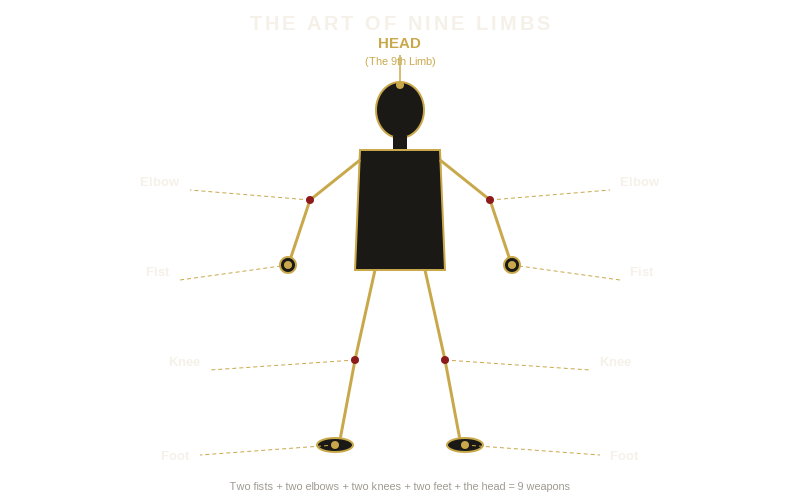
Every combat sport is defined not just by what it allows, but by what it demands. Boxing demands precision with two fists. Muay Thai demands fluency across eight weapons. Lethwei demands something more: mastery of nine weapons deployed without the cushion of padded gloves, across three distinct ranges of combat, with a singular emphasis on finishing power over accumulated points. This is the philosophy of the Art of Nine Limbs, and it shapes every technique a Lethwei fighter learns from the first day they step into a gym.
The most fundamental difference between Lethwei and every other major striking art is that there are no gloves. This single fact changes everything. In boxing, a fighter can throw hundreds of jabs over twelve rounds, knowing that the padding on their fists will absorb much of the impact on their own hands. In Muay Thai, the gloves allow fighters to shell up behind a high guard, absorbing shots on ten ounces of foam. In Lethwei, neither of these luxuries exists. A bareknuckle punch that misses the target and strikes the skull will break the hand. A high guard that works beautifully in a boxing gym becomes far less effective when the incoming fist is a bare knuckle aimed at the orbital bone. The absence of gloves forces Lethwei fighters to develop a different relationship with striking entirely — one built on precision, timing, and the willingness to commit fully to every shot.
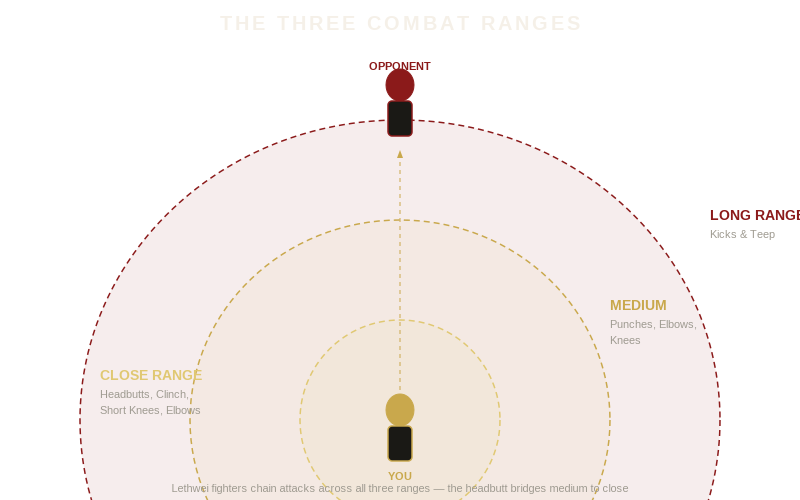
Lethwei technique is organized around three range zones, and understanding these zones is essential to understanding how fights unfold. The first is long range, which is the domain of kicks. At this distance, a fighter uses roundhouse kicks, push kicks, side kicks, and head kicks to control space, damage the opponent's legs, and set up entries into closer range. The second is medium range, where punches, elbows, and knees come into play. The third is close range — the clinchClose-range grappling position where fighters grip each other's head and neck to control posture and land knees, elbows and headbutts. — where headbuttsThe ninth limb., short elbows, knees to the body, and throws are available. The clinch is where Lethwei most visibly separates itself from other striking arts, because Lethwei permits the headbutt. The sources used for this guide do not rank the ranges or the techniques within them, and they do not count how often any technique is thrown, so this guide makes no claim about which range or weapon dominates a fight.
Chaining techniques across all three ranges in a single combination is a coaching ideal. A fighter might open with a low kickA powerful shin kick delivered to the opponent's outer or inner thigh, designed to damage the leg muscles and reduce mobility over the course of a fight. at long range, step into medium range with a cross-hook combination, then grab a collar tie and deliver a headbutt as the opponent shells up. This sequence is an illustration, not a documented Lethwei combination. A clinch game built for Thai boxing has to be rethought when the opponent is free to headbutt.
The final philosophical pillar of Lethwei technique is the emphasis on power over points. Under traditional rules, there are no judges and no scorecards. The only way to win is by knockout. Even under the modern World Lethwei Championship ruleset, which does use judges, the knockout remains the clearest way to win. As a coaching framing, techniques can be drilled with the finish in mind: a jab thrown to set up the cross, or a low kick thrown to dead the leg so the opponent cannot evade what follows. The sources used for this guide do not rank techniques or count how often any of them ends a fight.
Punches
Punching in Lethwei is a fundamentally different experience from punching in boxing or Muay Thai. The absence of gloves means that every punch carries more risk to the fighter throwing it. A hook that lands on the top of the skull instead of the jaw can shatter the metacarpal bones. A jab that catches the forehead instead of the nose can fracture the knuckles. This reality forces Lethwei fighters to develop extraordinary precision and an acute understanding of which targets are safe to strike with a bare fist. The chin, the temple, the liver, the solar plexus — these are the money targets. The skull, the elbow, the top of the head — these are the traps that punish sloppy technique.
The Lethwei Jab
The Lethwei jab is shorter and more compact than its boxing equivalent. Where a boxer fully extends the jab to maximize reach and use it as a rangefinder, the Lethwei jab is thrown with a slightly bent arm, keeping the fighter in a position to immediately follow up with a clinch entry or headbutt. The jab in Lethwei serves three purposes: it measures distance, it disrupts the opponent's rhythm, and it can set up entries into the clinch. A sharp jab to the nose forces the opponent to blink and raise their guard, creating the split second needed to shoot in for a collar tie and deliver a headbutt.
The Cross
The rear cross is a power punch that demands precise mechanics when thrown without gloves. The power of the cross comes from full body rotation — the back foot pivots, the hips turn over, the shoulder drives forward, and the fist lands with the first two knuckles aligned perfectly with the radius and ulna bones of the forearm. This alignment is critical in bareknuckle fighting because it channels the force straight through the arm structure rather than into the smaller bones of the hand. A cross thrown with the last three knuckles, a common mistake in gloved fighters transitioning to Lethwei, will eventually result in a boxer's fracture. Lethwei fighters drill the cross obsessively on heavy bags wrapped in thin canvas rather than padding, training the knuckles and wrist to absorb impact from the earliest stages of their development.
The Hook
Hooks in Lethwei come in two varieties: the head hook and the body hook. The head hook is thrown with a tight ninety-degree angle at the elbow, targeting the jaw or temple. Because there are no gloves to create a wider impact surface, the hook must be aimed with surgical accuracy — the jaw is the target, not the general area of the head. Body hooks, particularly the left hook to the liver, target a vulnerable area; the sources used for this guide do not rank them against other techniques.
The Uppercut
The uppercut occupies a unique place in Lethwei because of its relationship to the clinch. In boxing, the uppercut is typically thrown at medium range as a counter or inside a pocket exchange. In Lethwei, the uppercut can be deployed at extremely close range, including from within the clinch itself. A fighter holding a single collar tie with the left hand can fire a short, vicious uppercut with the right, snapping the opponent's head back and creating the perfect angle for a follow-up headbutt. This is a coaching illustration only: the sources used for this guide describe no canonical combinations or setups, so it should not be read as a documented Lethwei sequence. The uppercut can also be used as a counter against opponents who duck too low when attempting to enter the clinch, punishing them for lowering their head into the path of a rising fist.
The Hammer Fist
The hammer fist is a downward striking technique. Delivered with the bottom of the fist in a downward or diagonal arc, the hammer fist eliminates the risk of knuckle fractures because the impact surface is the fleshy base of the hand rather than the fragile knuckle bones. It can be used when an opponent ducks or is bent forward, allowing the fighter to bring the hammer fist down on the back of the head, the temple, or the base of the skull. While it lacks the precision-knockout power of a cross or hook, the hammer fist is an excellent tool for accumulating damage and creating openings, particularly when an opponent is turtling or covering up after being hurt.
The Backfist
The backfist is a whipping, rotational strike delivered with the back of the knuckles. It can be used as a surprise technique, for example thrown as a spinning backfistA rotational striking technique where the fighter spins 180 degrees and delivers a backfist to the opponent's head. to catch an opponent circling into the strike. The backfist generates its power from the speed of rotation rather than from planted weight transfer, making it less powerful than a cross but significantly faster and harder to see coming. Against opponents who rely on a tight, narrow guard, the backfist can arc around the guard and land cleanly on the temple. It is a high-risk, high-reward technique — when it lands, it produces spectacular knockouts, but when it misses, it leaves the fighter temporarily off-balance and vulnerable to counters.
Bareknuckle Mechanics: Why Everything Changes Without Gloves
The absence of gloves in Lethwei does not merely remove a layer of padding — it fundamentally alters the biomechanics of punching. Without gloves, the fist is smaller, which means strikes can fit through tighter gaps in the guard but also means the impact force is concentrated on a much smaller surface area. A bareknuckle punch to the jaw delivers its energy through roughly two square centimeters of knuckle, compared to the ten or more square centimeters of a gloved fist. This concentration of force is why bareknuckle punches cause more cuts and more immediate damage, but it is also why they demand more from the fighter's technique.
Lethwei fighters condition their hands from childhood. Knuckle push-ups on stone floors, striking buckets of sand, hitting canvas-wrapped heavy bags without wraps — these are standard training methods in Myanmar's gyms. The goal is not to create calluses but to strengthen the bones themselves through Wolff's law, the physiological principle that bones remodel and become denser in response to the stresses placed on them. A veteran Lethwei fighter's fist is a different instrument from an untrained hand — denser, harder, and far more resistant to fracture. But even with conditioned hands, precision remains paramount. The fighters who last longest in Lethwei are not necessarily the ones who hit hardest but the ones who hit cleanest.
The fist that misses the jaw finds the skull. The skull always wins.Myanmar Lethwei proverb
Kicks
Lethwei bears a resemblance to Muay Thai, and the sources make one comparison directly: Lethwei uses more punches and fewer kicks, because punches are generally favoured for their ability to draw blood more easily. As a coaching principle, a kick is thrown either to do damage or to create an opening for a closer-range weapon.
The Roundhouse Kick
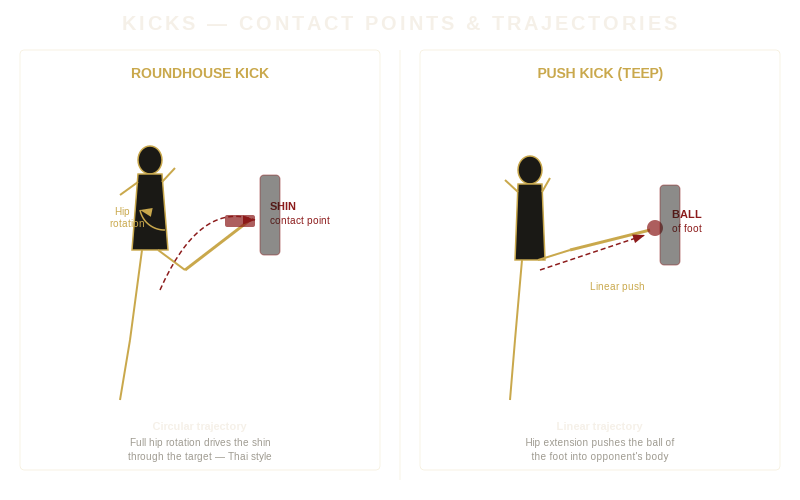
The roundhouse kick is a kick Lethwei shares with Muay Thai. Like its Muay Thai counterpart, the Lethwei roundhouse is thrown with the shin rather than the foot, generating power through a full rotation of the hips and a swinging motion of the entire leg. The fighter steps slightly off the center line, pivots on the ball of the lead foot, and whips the rear leg in a wide arc, making contact with the hard bone of the shin against the opponent's ribs, arm, thigh, or head. The shin is one of the hardest bones in the human body, and when conditioned through years of heavy bag work and banana tree kicking — a traditional Southeast Asian training method — it becomes a weapon capable of cracking ribs. A roundhouse to the body can sap an opponent's willingness to stand in the pocket, making them easier to push into the clinch.
The Push Kick (Teep)
The push kick, universally known by its Thai name “teepFront push-kick with the sole or ball of the foot, used to maintain range and disrupt an opponent's rhythm.,” is the longest-range weapon in a Lethwei fighter's arsenal. It is a straight, thrusting kick delivered with the ball of the foot to the opponent's midsection, hip, or thigh. The teep serves primarily as a range management tool — it keeps aggressive opponents at distance, disrupts their forward momentum, and resets the fight to long range where the kicker has the advantage. In Lethwei, the teep takes on additional importance because of the clinch threat. A fighter who excels at the teep can prevent clinch-heavy opponents from ever closing the distance to land headbutts and knees. The teep can also be used offensively, particularly to the solar plexus, where a well-timed thrust kick can steal a fighter's breath and leave them momentarily defenseless.
The Side Kick
The side kick is thrown by fighters with the flexibility and timing to use it effectively; the sources used for this guide do not say how often it appears in Lethwei. Thrown by turning the body sideways and thrusting the heel or blade of the foot into the opponent's midsection or knee, the side kick generates enormous stopping power through linear force. Unlike the roundhouse, which travels in an arc, the side kick drives straight through the target, making it extremely difficult to absorb. Some modern Lethwei fighters with backgrounds in karate or taekwondo have brought the side kick into their Lethwei game to great effect, using it as a mid-range tool to create distance and damage the body.
The Spinning Back Kick
The spinning back kick is a rotational heel strike. The fighter turns their back to the opponent, looks over the shoulder to find the target, and drives the heel backward into the opponent's body or head with the full rotational force of the spin behind it. The body presents a larger target than the head and the consequences of missing are less severe. A clean spinning back kick to the solar plexus can end a fight instantly, folding even the most conditioned fighter in half. It is a technique that requires exceptional timing and courage, because the moment of the spin creates a brief window of vulnerability where the fighter cannot see their opponent.
The Ax Kick
The ax kick is a dramatic, visually striking technique in which the fighter raises the leg high overhead and brings the heel crashing down on the opponent's shoulder, collarbone, or head. The ax kick suits opponents who are bent forward, ducking punches, or recovering from a clinch break. The downward trajectory makes it difficult to check or block with conventional defenses, and the heel delivers concentrated force to whatever it strikes. It can be used as a surprise weapon, particularly against shorter opponents who spend much of the fight in a crouched stance.
Low Kicks: Calf and Thigh Targeting
Low kicks — strikes to the calf, the outside of the thigh, and the inside of the thigh — are covered here as a coaching topic; the sources used for this guide do not rank them against other techniques. A persistent low kick attack degrades the opponent's mobility over the course of a fight, reducing their ability to circle, check kicks, and escape the clinch. The calf kick, which has risen to prominence in MMA and kickboxing in recent years, is used to attack the peroneal nerve on the outside of the lower leg and cause the foot to go numb. The inside thigh kick targets the femoral nerve and can dead the entire leg with repeated clean strikes. In a sport where knockout is the only traditional path to victory, destroying an opponent's ability to move is one coaching approach to setting up the finish; the sources do not document how often it works.
Head Kicks and Their Setup
The head kick targets the head with a roundhouse. A clean roundhouse kick to the temple or jaw produces instantaneous unconsciousness — there is no fighting through it, no toughness that can overcome it. But landing a head kick requires careful setup because the head is the smallest and most mobile target. Coaches describe several ways to set up a head kick: repeated low kicks to the same leg, which conditions the opponent to drop their guard to check, followed by a sudden high kick over the lowered hand; body kicks that force the opponent to drop their elbow to protect the ribs, opening the path to the head; and feinted punches that draw the opponent's attention to the hands while the kick arcs toward the temple.
Elbow Strikes
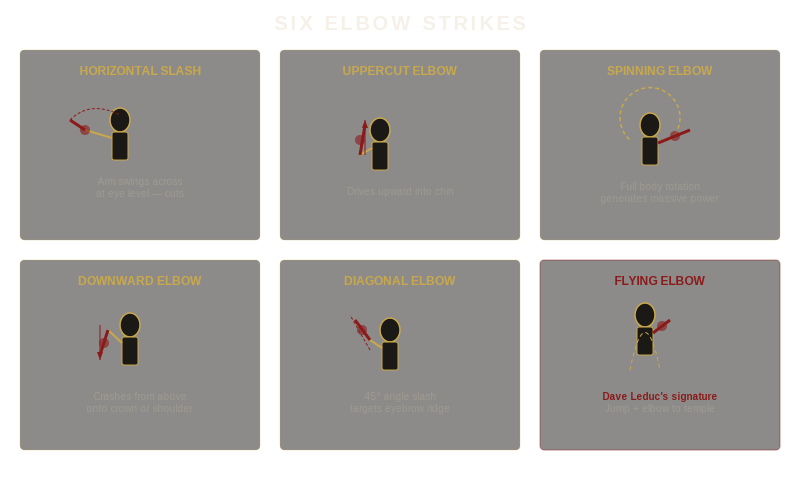
Elbows are the close-range cutting weapons of Lethwei. The elbow is the hardest point on the human body, and when driven into the soft tissue of the face, it opens cuts with surgical efficiency. In Muay Thai, elbows are respected and feared, but in Lethwei they take on an even more dangerous dimension because there are no gloves to cushion or deflect them. A Muay Thai fighter can partially block an elbow with the padding of their glove; a Lethwei fighter must rely entirely on head movement, distance management, or their own counter-strikes to avoid the elbow's edge. This makes elbow exchanges in Lethwei extraordinarily violent.
Horizontal Elbow
The horizontal elbow is a fundamental elbow technique. It is thrown by swinging the arm in a horizontal arc, leading with the point of the elbow, across the opponent's face at eye level. Targets include the brow ridge, the temple, or the cheekbone. The horizontal elbow is fast, difficult to see coming from the blind angle, and generates enough force through hip rotation to open deep cuts that can blind a fighter with their own blood. It is thrown from both the lead and rear sides and can be used as an offensive weapon, a counter, or a technique from within the clinch.
Uppercut Elbow
The uppercut elbow travels on a vertical path from low to high, driving the point of the elbow upward into the chin or the underside of the jaw. It is used as a counter against opponents who duck low or lean forward, punishing their level change with a rising elbow that snaps the head back. In the clinch, the uppercut elbow can be thrown from a pummel position, where the fighter uses the free arm to drive the elbow vertically into the opponent's face at extremely close range.
Spinning Elbow
The spinning elbow is a rotational elbow strike. The fighter rotates their entire body, using the momentum of the spin to add tremendous force to the elbow strike. The spinning elbow can travel horizontally or diagonally, and when it lands clean, it carries enough force to produce instant knockouts against any fighter regardless of their chin or conditioning. The technique is high-risk because the spin momentarily blinds the fighter to their opponent's position, but the reward — a potential fight-ending strike from an unexpected angle — makes it a high-reward weapon.
Downward Elbow
The downward elbow, sometimes called the twelve-to-six elbow, drops the point of the elbow vertically onto the top of the opponent's head, the crown, or the back of the neck. While illegal in MMA, this technique is entirely legal in Lethwei and can be used against opponents who shoot for clinch entries with their head low. The downward elbow is also effective when an opponent is hurt and bending forward, allowing the fighter to hammer the elbow down onto the exposed skull or the base of the neck.
Diagonal Elbow
The diagonal elbow travels on a forty-five-degree angle, either slashing downward from high to low or cutting upward from low to high. The downward diagonal is particularly effective as a cutting tool against the eyebrow, where the thin skin splits easily under the sharp point of the elbow. The upward diagonal is used as a close-range counter, driven into the chin or jaw of an opponent who has stepped into range. The diagonal path makes this elbow versatile — it can be used from multiple positions and angles, making it a reliable tool in scrambles and exchanges where a perfectly horizontal or vertical elbow might not find its mark.
Flying Elbow
The flying elbow is a leaping elbow strike. The fighter leaps off the ground and drives the elbow downward into the opponent from above, using gravity and the momentum of the jump to add force. It can be thrown as a finishing technique against an opponent who is hurt, backing up, or caught against the ropes. Its psychological impact is enormous — it signals absolute aggression and confidence, and when it lands, it produces knockouts that become the highlights replayed across social media and broadcast television for years afterward.
What makes elbows more dangerous in Lethwei than in Muay Thai is not the techniques themselves — the mechanics are fundamentally similar — but the context. Without gloves to absorb or redirect incoming elbows, without the padded guard that Thai boxers use to cover up, every elbow that finds its mark in Lethwei lands with its full force on bare skin and bone. The cuts are deeper. The knockouts are more sudden. The cumulative damage over a fight is more severe. The sources used for this guide do not rank elbows against other close-range weapons or count how often they end fights.
Knee Strikes
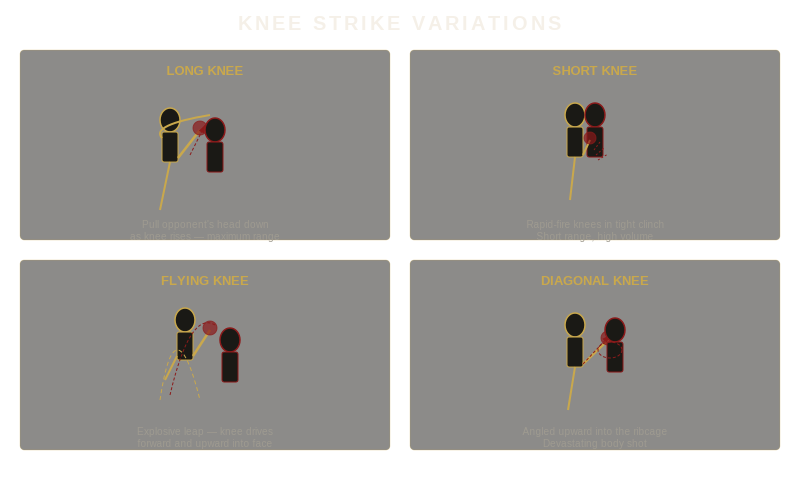
Knee strikes are permitted in Lethwei and deliver force through one of the largest and hardest bones in the human body directly into soft tissue targets. The knee is thrown in the clinch, but it is also deployed at range as a flying technique and as a counter against opponents moving forward. The sources used for this guide do not count how often knees are thrown or rank them against other weapons.
The Long Knee
The long knee is a driving, thrusting technique where the fighter steps forward and drives the knee upward and forward into the opponent's midsection from outside clinch range. The power comes from the forward momentum of the step combined with a sharp hip thrust that drives the knee through the target. The long knee is used as both an offensive entry and a counter — thrown as the fighter steps into range to initiate a clinch, or fired as a counter against an opponent rushing forward, using their own momentum against them. A clean long knee to the solar plexus is a strike that can cause immediate collapse.
The Short Knee
The short knee is the clinch-range companion to the long knee. Thrown from inside the double collar tie or single collar tie position, the short knee is a sharp, upward spike that targets the body, the thigh, or — when the opponent is pulled downward — the head. The mechanics are compact: rather than stepping into the technique, the fighter uses the grip on the opponent's head or neck to pull them down while simultaneously driving the knee upward, creating a collision of forces that multiplies the impact. The short knee is thrown from clinch range, though no source counts how often it is thrown or what share of stoppages it accounts for, so this guide makes no claim either way.
The Flying Knee
The flying knee is a leaping knee strike. The fighter launches off the ground, driving one knee upward while the other leg pushes off, directing the full mass of the body behind the point of the knee into the opponent's head or body. The flying knee is used as a blitz technique — thrown with explosive speed to close distance and land before the opponent can react. It is particularly effective against opponents who are backing up, circling into the line of the knee, or emerging from a clinch break.
The Diagonal Knee
The diagonal knee strikes on an angled path, targeting the ribs, the floating ribs, or the outer thigh. Rather than traveling straight up, the diagonal knee curves inward, making it effective from awkward angles within the clinch where a straight knee cannot find a clean path. The diagonal knee can be thrown in rapid succession — three or four knees pumped into the same rib on the same side — to break down the opponent's body systematically. This accumulation strategy is particularly effective in the later rounds when a fighter's body has already absorbed punishment.
Clinch Knee Mechanics
The mechanics of throwing knees from the clinch deserve special attention because the clinch is where the short knee is thrown. The key to effective clinch knees is the pull-and-drive rhythm: the fighter controls the opponent's posture through the collar tie, pulls the head and torso downward and toward the knee, and simultaneously drives the knee upward into the descending target. This synchronized pulling and striking creates far more impact than the knee alone could generate. Advanced fighters vary the rhythm of their pulls and knee strikes, sometimes pulling without striking to break the opponent's posture, sometimes striking without pulling to catch them off-guard, keeping the opponent constantly guessing and unable to brace for impact.
In the clinch, the knee does not merely strike the body — it strikes through it. The pull of the collar tie and the drive of the knee create a collision no amount of conditioning can prepare you for.
The Headbutt — The 9th Limb
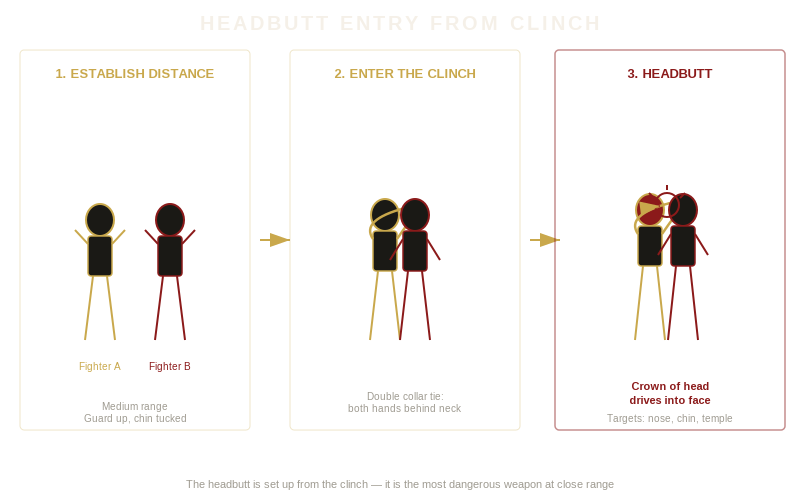
The headbutt is the ninth limb of the Art of Nine Limbs. Lethwei permits the headbutt as a legal technique in the ring, and the sources record seven named headbutt types, though without describing them. They do not describe any codified setups or defensive counters, so the setup, timing, and defence notes below are general coaching description rather than a documented Lethwei syllabus.
The Forward Headbutt
The forward headbutt, also described as the thrusting headbutt, is one of seven named headbutt types, alongside the upward, side, clinching, flying or diving, rushing, and downward headbutts. A separate type, the clinching headbutt, is the one the sources tie to the clinch; where the forward headbutt is thrown from is not something they say. The sources used for this guide do not specify which part of the head is used as the striking surface, or which targets are aimed at, so this guide does not state either.
The Side Headbutt
The side headbutt is one of the seven named headbutt types. The sources used for this guide do not describe its striking surface, its path, or its targets, so this guide does not either. What they do record is individual landed headbutts in particular fights — one to the temple in the clinch that floored Tun Tun Min, described without naming a type, and a diving headbutt that landed on Corentin Jallon's right eye and drew blood. Fight records also credit knockouts to headbutts without describing how they were thrown.
Targets and Legality
Headbutts are permitted in Lethwei. The sources used for this guide do not give a list of target areas, or of areas where a headbutt is prohibited, so this guide does not list any. Rulesets differ between traditional Lethwei and modern promotions, so check the rules of the specific event before competing.
Setup from the Clinch
One of the seven documented types is the clinching headbutt, and several of the landed headbutts the sources describe came in a clinch. Others are recorded without a position — a diving headbutt that landed on an opponent's right eye, for one. How they divide up is not something any source counts. The positions below are the standard clinch grips rather than a documented Lethwei syllabus. In the double collar tie, both hands grip behind the opponent's neck, allowing the fighter to control the opponent's head position and pull them into the headbutt. In the single collar tie, one hand grips behind the neck while the other controls the bicep or wrist, creating an asymmetric position from which the fighter can angle the opponent's head into the path of the headbutt. A headbutt thrown without head control is easier to evade and can leave the fighter off-balance. A headbutt thrown with a solid collar tie, where the opponent's head is held in place or pulled into the strike, is harder for the opponent to move away from, which is the coaching logic for controlling the head first. The sources do not measure how often such headbutts land.
Timing: When the Headbutt Strikes
The sources used for this guide do not describe when in an exchange the headbutt is thrown, so the three timing windows below are a coaching framework, not a documented Lethwei list. The first is upon entering the clinch — as the fighter closes distance and secures a collar tie, they immediately fire a headbutt before the opponent can establish their own grips and defensive posture. The transition from striking range to clinch range creates a moment of uncertainty where the opponent's hands are adjusting from guard to clinch position. The second timing window is during the clinch break — as the fighters separate, either voluntarily or at the referee's command, the fighter fires a parting headbutt in the moment before distance is fully established. The third is as a counter against a rushing opponent — when a fighter charges forward with wild punches or attempts to bull their way into the clinch, the defender plants their feet and drives their head forward into the incoming opponent. Each timing window calls for different footwork, head positioning, and collar-tie control.
Headbutt Defense
The sources used for this guide describe no canonical headbutt defences, so what follows is general coaching description. One approach is the chin tuck — keeping the chin down as a baseline posture. Another is head movement — slipping the head laterally so that the headbutt glances off rather than landing flush. A third is creating distance — using push kicks, long-range punches, and lateral footwork to prevent the opponent from reaching clinch range. These can be combined: keeping the chin tucked as a baseline, moving the head actively when clinched, and using distance management to limit the number of clinch exchanges per round. Ring generalship — controlling the center of the ring, avoiding the ropes, dictating the range of engagement — also reduces headbutt exposure, because the fighter who controls where the fight happens controls whether clinch exchanges happen.
The headbutt is not a street fight move that somehow ended up in a sport. It is a refined, technical weapon. The greatest Lethwei fighters use it the way a surgeon uses a scalpel.Dave Leduc, WLC World Champion
Clinch Fighting & Dirty Boxing
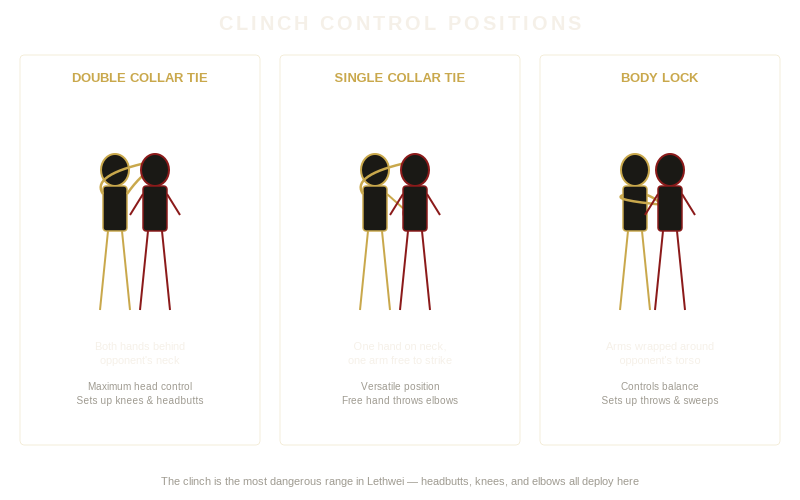
The clinch is the close range of Lethwei, where the headbutt is available alongside knees, elbows, short punches, and throws, all within inches of the opponent. The sources used for this guide do not say how often fights are decided in the clinch or rank it against the other ranges.
The Double Collar Tie
The double collar tie is a standard clinch grip; the sources used for this guide do not rank clinch positions or say which one Lethwei fighters favour. Both hands clasp behind the opponent's neck, with the forearms pressing against the collarbones and the elbows squeezing inward to control the opponent's posture. From this position, the fighter can deliver knees to the body and head, pull the opponent into headbutts, and manipulate their posture to set up throws. Achieving the double collar tie is a common coaching goal, and the battle for this position — the pummeling, hand fighting, and grip breaking that occurs when both fighters are trying to secure it — is physically demanding.
The Single Collar Tie
The single collar tie places one hand behind the opponent's neck while the other hand controls the opponent's arm at the bicep, wrist, or elbow. This asymmetric position offers less control than the double collar tie but more versatility — the controlling hand on the arm can be used to clear space for punches, create angles for headbutts, or set up throws by manipulating the opponent's balance. The single collar tie can be a transitional position on the way to the double collar tie, and offense can be thrown from it before the opponent has time to establish double ties of their own.
The Pummel Position
Pummeling is the battle for inside position in the opening moments of a clinch exchange. Both fighters work their arms to swim inside the opponent's arms, fighting for underhooks and collar ties while denying the same to their opponent. The pummel is an exhausting, technique-intensive phase where conditioning and grip strength matter. A fighter who wins the pummel gains control of the clinch. In Lethwei, short punches, elbows, and headbutts can be thrown while fighters work for position, turning what in wrestling would be a purely grappling exchange into a striking exchange as well.
Weapons from the Clinch
The clinch unlocks a full arsenal of weapons, and the sources do not rank them. Knees can be thrown into the body, the thighs, and — when the opponent's head is pulled down — the face. Short elbows are used to cut and damage, particularly the horizontal elbow and the uppercut elbow, which can be thrown in the tight confines of the clinch without needing much space to generate power. The headbutt, as discussed above, is also permitted. Lethwei further allows a form of dirty boxing from the clinch — short hooks, uppercuts, and hammer fists thrown at extremely close range while maintaining a grip with the other hand. This combination of grappling control and short-range striking is what makes the Lethwei clinch so uniquely dangerous and so difficult for fighters from other disciplines to navigate.
Breaking the Clinch
Breaking the clinch — separating from an opponent who has secured strong grips — is a defensive skill. One method is the frame, where the fighter places their forearm across the opponent's chest or throat and pushes away, creating enough distance to disengage. The swim, where the fighter ducks under the opponent's arms and circles out, is another option. A sharp push kick to the midsection, thrown as the fighter breaks the grips, can create immediate distance. Some fighters use a short headbutt or uppercut as a parting shot while breaking, punishing the opponent for holding the clinch and discouraging them from re-engaging.
The Lethwei Walk
The Lethwei walk is a clinch-control technique. The name does not appear in the sources behind this guide, so treat what follows as coaching description. When a fighter establishes strong grips — for example a double collar tie — they begin walking the opponent backward across the ring, driving them toward the ropes while delivering knees, headbutts, and short elbows with every step. The walk is physically overwhelming, combining forward pressure with a constant stream of strikes that gives the retreating fighter no opportunity to reset, breathe, or mount a defense. It signals control of the fight, and a fighter who cannot reverse the pressure has to regain the center of the ring.
Throws, Sweeps & Takedowns
Lethwei is not a grappling art, and it does not permit ground fighting. But it does permit throws, sweeps, and takedowns as techniques used to displace the opponent and create openings for follow-up strikes. The distinction is important: in Lethwei, a throw is not the end goal as it would be in judo. It is a tool that puts the opponent on the canvas and allows the thrower to land strikes on the rising opponent. The referee stands fighters up immediately after a takedown, but the fighter who was thrown must rise — often dazed, off- balance, and disoriented — into the path of an opponent who is already in position to strike.
The Hip Throw
The hip throw is one of the throws used in Lethwei. From the clinch, the fighter turns their hips into the opponent, drops their center of gravity below the opponent's, and rotates, sending the opponent over their hip and onto the canvas. The Lethwei hip throw borrows heavily from judo's o-goshi but is executed with less grip refinement and more brute force, reflecting the striking-first mentality of the sport. The impact of landing on the hard canvas after a hip throw can itself cause damage, and the disorientation of being inverted and dropped creates a window for the thrower to land punches or knees as the opponent struggles to regain their feet.
The Leg Sweep
Leg sweeps in Lethwei function similarly to the sweeps in Muay Thai and judo. When the opponent commits weight to one leg — for example while throwing a kick or stepping forward — the fighter hooks the supporting ankle with their own foot and pulls it out from under them, sending the opponent crashing to the canvas. The timing must be precise: the sweep works because the opponent is mid-weight-transfer and unable to recover balance. An early or late sweep will fail. A perfectly timed sweep deposits the opponent flat on their back with maximum impact and maximum embarrassment, both of which matter in a sport where psychological momentum is a significant factor.
The Ankle Pick
The ankle pick is a quick, opportunistic takedown where the fighter drops low, grabs the opponent's ankle or lower leg, and lifts it while pushing the opponent backward with the other hand on the chest or shoulder. The ankle pick suits opponents in a wide, square stance who have their lead foot within easy reaching distance. It is a technique that requires speed and commitment rather than strength — the fighter must shoot in quickly, secure the ankle, and complete the takedown before the opponent can sprawl or step back out of range.
The Body Lock Takedown
The body lock takedown involves securing both arms around the opponent's torso, locking the hands, and lifting or twisting them to the ground. In Lethwei, the body lock can be secured from the clinch when the fighter fails to achieve collar ties but manages to get both arms around the body. The takedown is executed by arching the back, popping the hips, and driving the opponent either straight down or over to the side. The body lock takedown is physically demanding but highly effective against opponents who are difficult to throw with hip techniques, particularly shorter, stockier fighters with a low center of gravity.
A fighter who throws their opponent to the canvas can achieve several goals at once: they demonstrate physical control, they disrupt the opponent's rhythm and confidence, they create an opportunity for follow-up strikes on the rising opponent, and they send a message to the crowd and — under modern rules — the judges. The sources used for this guide do not count how often throws are used or rank them against strikes.
Defensive Techniques
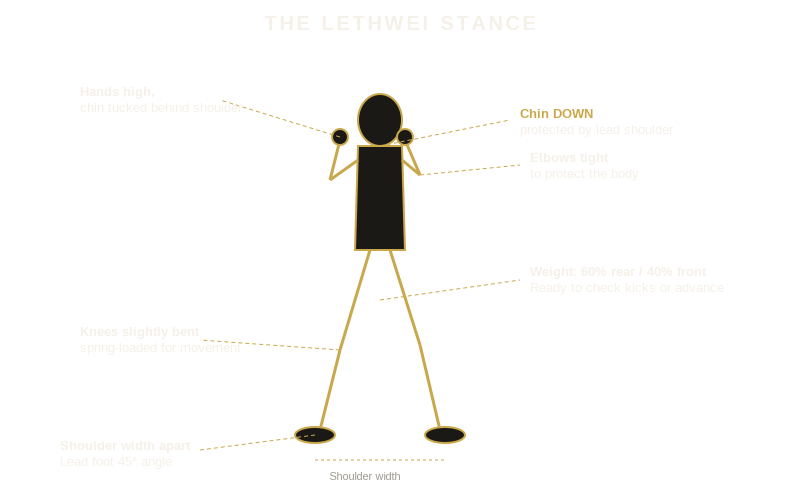
The absence of gloves removes the padded guard that boxers and Thai boxers use, and the inclusion of headbutts adds an additional weapon that must be accounted for at close range. A Lethwei fighter's defensive toolkit must cover every weapon across every range, from long-range kicks to clinch-range headbutts, and it must do so with bare hands and raw reflexes.
Parrying
Parrying is the art of redirecting incoming strikes with small, precise hand movements rather than absorbing them on a stationary guard. In Lethwei, parrying is more important than in gloved sports because the guard itself is less effective without padding. A well-executed parry deflects the punch just enough to miss the target while keeping the defender in position to counter immediately. The parry is used primarily against straight punches — the jab and the cross — where the incoming trajectory is predictable and can be redirected with a quick flick of the palm or the back of the wrist. Against hooks and uppercuts, parrying is less effective, and the fighter must rely on other defensive tools.
Bob and Weave
The bob and weave is a head movement pattern borrowed from boxing, where the fighter bends at the knees and waist to move their head below the path of incoming hooks and overhands, then rises on the opposite side in position to counter. In Lethwei, the bob and weave is used more cautiously than in boxing because ducking too low invites uppercuts, knees, and downward elbows — weapons that are not available in boxing. The Lethwei bob is shallower, a subtle dip rather than a deep duck, keeping the fighter low enough to evade the strike but high enough to see and react to the counter-weapons that follow.
The Shoulder Roll
The shoulder roll, made famous by Floyd Mayweather in boxing, has been adapted by some Lethwei fighters as a defensive technique against straight punches. The fighter turns their lead shoulder upward toward the chin, using the shoulder to deflect the incoming punch while keeping the rear hand in position to counter. Without the padding of a glove to catch deflected punches, the shoulder roll in Lethwei requires even more precise timing — the shoulder must meet the punch at the right angle to deflect it cleanly rather than allowing it to slide over and hit the jaw. It is a high-skill technique used by technically advanced fighters who have the reflexes and ring intelligence to read punches early.
Checking Kicks
Checking a kick means lifting the lead leg so that the shin meets the incoming kick, blocking it bone-on-bone. The check is the standard defense against roundhouse kicks to the body and legs, and it is as fundamental to Lethwei as it is to Muay Thai. A well-timed check can be more punishing to the kicker than to the defender — striking a raised shin with a roundhouse kick sends a jolt of pain through the kicker's own shin. Fighters who check kicks consistently force their opponents to abandon the kicking game or risk accumulating damage on their own legs. The check can be combined with a simultaneous catch attempt, where the defender checks with the shin but also reaches to grab the incoming leg, transitioning from defense to offense.
Catching Kicks
Catching a kick involves trapping the opponent's kicking leg under the arm after it lands, immobilizing the opponent in a compromised one-legged position. From the catch, the fighter can sweep the standing leg, throw punches to the unguarded head, or drive forward with knees and elbows while the opponent hops helplessly on one foot. The kick catch is particularly dangerous in Lethwei because the follow-up options include headbutts — the fighter catches the kick, steps into clinch range while holding the leg, and throws a headbutt at the trapped opponent. This is a coaching illustration, not a documented Lethwei sequence.
Headbutt Defense
Defending the headbutt can draw on the techniques described in the headbutt section above: the chin tuck, lateral head movement, and distance management. Frame control is another option — keeping the forearms between yourself and the opponent to create a physical barrier against closing to headbutt range. As in the section above, this is coaching description; the sources used for this guide document no canonical headbutt defences.
Ring Generalship
Ring generalship is the overarching defensive strategy that ties all individual techniques together. It refers to a fighter's ability to control the geography of the fight — dictating where in the ring the exchanges happen, at what range, and on what terms. A fighter with superior ring generalship keeps to the center of the ring, uses lateral movement to avoid being cornered or pushed against the ropes, and controls the distance so that the fight happens at the range where they are strongest. Against a clinch-heavy opponent, ring generalship means maintaining distance with footwork and teeps. Against a kicker, it means closing distance and engaging at medium range. Ring generalship is the invisible defense — the defense that prevents attacks from ever being launched.
Animal-Inspired Styles
Throughout its long history, Lethwei has developed informal fighting styles named after the animals whose movement patterns they resemble. These are not rigid systems with fixed curricula — they are descriptive categories that fighters and commentators use to characterize a fighter's overall approach, temperament, and preferred techniques. A fighter does not choose an animal style from a menu; rather, their natural physical attributes, temperament, and training environment shape their approach, and the animal designation is applied after the fact. Treat them as informal descriptive shorthand rather than documented Lethwei technique; the sources used for this guide do not rank them or count how often fighters match them.
Cobra Style
The Cobra style fighter is quick, upright, and precise. Like the snake for which the style is named, the Cobra fighter strikes with speed from an almost stationary base, then retreats before the opponent can counter. The stance is tall, the footwork is light, and the typical weapons are the jab, the cross, and the teep — all long-range tools that allow the fighter to inflict damage without entering the dangerous clinch range. Cobra fighters are typically counter- strikers who allow the opponent to come forward, pick them apart with sharp, darting combinations, and then disengage before the clinch can be established. Their defense relies on reflexes and footwork rather than durability, and they tend to win fights through accumulation of clean strikes rather than single heavy blows. The Cobra style suits aggressive, forward- pressing opponents but can be neutralized by fighters who cut off the ring and force the Cobra into close range where their speed advantage is diminished.
Bull Style
The Bull style is the polar opposite of the Cobra. Bull fighters march forward relentlessly, absorbing punishment to get into clinch range where their superior strength and endurance can be deployed. The Bull relies on forward pressure, a granite chin, and heavy clinch work — double collar tie control, grinding knee strikes, headbutts, and short elbows delivered in a ceaseless barrage that exhausts and overwhelms the opponent. Bull fighters typically have thick, muscular builds, exceptional cardio, and an almost supernatural ability to walk through punishment that would stop other fighters. They do not try to avoid getting hit — they accept damage as the price of closing distance and then make the opponent pay a higher price in the clinch. The Bull style is vulnerable to disciplined Cobra fighters who can maintain distance for the full fight, but few fighters have the footwork and endurance to keep a true Bull at bay for five rounds.
Eagle Style
The Eagle style is characterized by long-range fighting, powerful kicks, and spectacular spinning techniques. Eagle fighters tend to be tall, rangy athletes with exceptional flexibility and the ability to generate enormous power through hip rotation. Their typical weapons are the roundhouse kick, the head kick, the spinning back kick, and the spinning elbow — techniques that use the full range of the fighter's reach and the momentum of rotation. Eagle fighters maintain distance, control the center of the ring, and use their superior reach to launch attacks from ranges where the opponent cannot reach them. They are often the most exciting fighters to watch because of their willingness to throw high-risk, high-reward techniques — a spinning back kick that misses leaves the fighter completely exposed, but one that lands can end the fight from any round and any position. The Eagle style suits shorter opponents and Bull style fighters who struggle to close the distance against long-range weaponry. It is vulnerable to experienced clinch fighters who can weather the initial striking storm and drag the Eagle into close range where their long limbs become a disadvantage.
These three animal styles represent the broad strategic spectrum of Lethwei, but a fighter is not confined to a single approach. As an illustration, a fighter might fight like a Cobra in the early rounds to pick the opponent apart from range, switch to the Bull when the opponent is tired and vulnerable in the clinch, then finish with an Eagle-style head kick when the guard drops.